
оставить сообщение
Если вас заинтересовала наша продукция и вы хотите узнать более подробную информацию, пожалуйста, оставьте сообщение здесь, мы ответим вам как можно скорее.

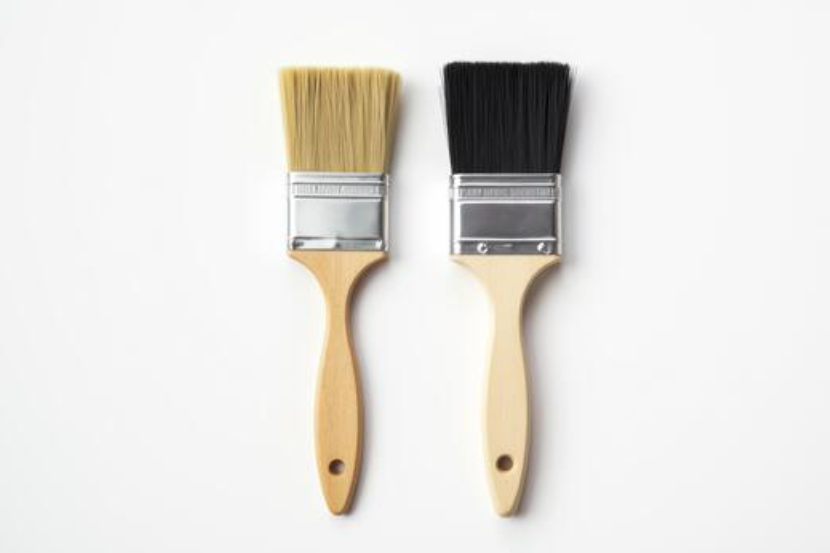
When it comes to paint brush performance, most attention lands on bristles and ferrules. Few buyers stop to think about the small wedges inside the ferrule that lock the bristle pack in place. Yet wedge material is one of the most impactful, underdiscussed choices in brush manufacturing. It directly affects assembly consistency, product durability, and production waste. Today, wedges are commonly made from two core material families—wood and plastic—and within plastics, secondary (regrind) PE has emerged as a leading practical option.
Traditional wooden wedges have a long history in the industry. They are low in raw material cost and readily available in basic sizes. However, they carry significant production drawbacks. Wood absorbs moisture from the air or production environment, causing uneven swelling that shifts bristle tension and often creates the “fish mouth” defect at the brush tip. Natural density variations also mean wider thickness tolerances, leading to inconsistent bristle packing across batches. Wooden wedges also splinter during machine insertion, generating waste and contaminating bristle packs.
Plastic wedges eliminate nearly all of these issues. Their dimensional stability is unaffected by humidity, so bristle tension remains consistent in any climate. Precision extrusion delivers tight thickness tolerances, ensuring uniform bristle density across every brush. They produce no splinters, run smoothly on automated assembly lines, and resist cracking over time. The main tradeoff is slightly higher upfront material cost, but this is offset by lower scrap rates, faster production, and fewer quality returns. On balance, plastic wedges outperform wood for nearly all modern brush production.
Not all plastic wedges are equal. Common options include virgin PE, polypropylene (PP), PVC, and secondary PE regrind. Virgin PE offers excellent toughness and consistency but comes at a premium price. PP provides higher rigidity but is more brittle, cracking easily during high-speed insertion. PVC is low-cost but raises environmental and regulatory concerns in many export markets.
Secondary PE regrind—recycled polyethylene processed to consistent specification—strikes the ideal balance. It retains the core benefits of virgin PE: good impact resistance, reliable dimensional stability, and water resistance. Because it uses recycled feedstock, it costs substantially less than virgin material, lowering production costs without sacrificing functional performance. The only minor limitation is slightly less uniform color, which is irrelevant for an internal component hidden inside the ferrule.
As a manufacturer of paint brush production equipment, we also produce high-quality PE regrind wedges engineered for precision assembly. Built on our in-depth expertise in automated bristle-setting machinery, our wedges are made to strict thickness tolerances, and fully compatible with high-speed production lines. Custom sizes and specifications are available to match your exact production needs.


 Поддерживается сеть IPv6
оставить сообщение
Сканировать в Wechat :

Сканировать в WhatsApp :